2016年11月25日 星期五

Week 11

Syllabus of week 11: 👀


⏩Toni Morrison  is an American novelist, editor, and professor. Her novels are known for their epic themes, vivid dialogue, and richly detailed characters. Among her best known novels are The Bluest Eye (1970), Sula(1973), Song of Solomon (1977), and Beloved (1987). 
Toni Morrison 2008-2.jpg

⏩The Bluest Eye is a 1970 novel by American author Toni Morrison. It is Morrison's first novel and was written while she was teaching at Howard University and raising her two sons on her own. The story is about a year in the life of a young black girl named Pecola who develops an inferiority complex due to her eye color and skin appearance. It is set in Lorain, Ohio, against the backdrop of America's Midwest during the years following the Great Depression. 

⏩To Kill a Mockingbird is a novel by Harper Lee published in 1960. It was immediately successful, winning the Pulitzer Prize, and has become a classic of modern American literature. The plot and characters are loosely based on the author's observations of her family and neighbors, as well as on an event that occurred near her hometown in 1936, when she was 10 years old.
Cover of the book showing title in white letters against a black background in a banner above a painting of a portion of a tree against a red background

⏩Macbeth is a tragedy written by William Shakespeare. Set mainly in Scotland, the play dramatises thedamaging physical and psychological effects of political ambition on those who seek power for its own sake. The play is believed to have been written between 1599 and 1606.

​The earliest account of a performance of what was probably Shakespeare's play is April 1611, when Simon Forman recorded seeing such a play at the Globe Theatre. It was first published in the Folio of 1623, possibly from a prompt book.

2016年11月18日 星期五

Week 10

Syllabus of week 10: 👀

⏩cumulative tale
In a cumulative tale, sometimes also called a chain tale, action or dialogue repeats and builds up in some way as the tale progresses. With only the sparest of plots, these tales often depend upon
 repetition and rhythm for their effect, and can require a skilled storyteller to negotiate their tongue-
twisting repetitions in performance. The climax is sometimes abrupt and sobering as in "The Gingerbread Man." The device often takes the form of a cumulative song or nursery rhyme.
⏩ Why Mosquitoes Buzz in People's Ears: A West African Tale is a picture book by Verna Aardema and illustrated by Leo and Diane Dillon told in the form of a cumulative tale written for young children, which tells an African legend. In this origin story, the mosquito lies to a lizard, who puts sticks in his ears and ends up frightening another animal, which down a long line causes a panic. In the end, an owletis killed and the owl is too sad to wake the sun until the animals hold court and find out who is responsible. The mosquito is eventually found out, but it hides in order to escape punishment. So now it constantly buzzes in people's ears to find out if everyone is still angry at it.

This story is a resource for teachers to teach the skill cause and effect: 
"A cause is something that makes something else happen; An effect is what happens as a result of the cause"

2016年11月4日 星期五

Week 8

Syllabus of week 8:👀


⏩mother goose:  is an imaginary author of a collection of fairy tales and nursery rhymes[1] often published as Mother Goose Rhymes. As a character, she appears in one nursery rhyme.

⏩children's literature:includes stories, books, magazines, and poems that are enjoyed by children. Modern children's literature is classified in two different ways: genre or the intended age of the reader.
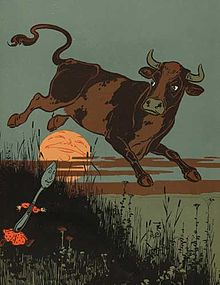
⏩hey diddle diddle: is an English nursery rhyme. It has a Roud Folk Song Index number of 19478.
Hey Diddle Diddle 2 - WW Denslow - Project Gutenberg etext 18546.jpg

⏩Nursery Rhyme- Mother Goose(Charles Perrault)

Post Ads (Documentation Required)

Author Info (Documentation Required)